
THE SECOND EVOLUTION
BY DANNY VENDRAMINI
THE PRINCIPAL TEEM THEORY HYPOTHESES
(Continued)
Page 2 (of 3)
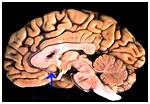 |
9 The Monitory System hypothesisThis hypothesis argues that all teemic species, from worms to whales have evolved unique neural modules and sensory organs that allow them to monitor for the environmental cues that trigger teems. In humans, this module is housed in the amygdaloid complex, deep within the limbic system of our brains. The module reviews the constant stream of transduced emotional stimuli from all our sensory organs (including our skin) and when a teemic emotion is detected, it triggers the teem and the emotions are expressed.The monitory system operates independently of our brains, (even when we’re asleep) so remains a largely subliminal process. Nevertheless, it influences every aspect of our lives. In practical terms, most of the stressed anxieties, depression, paranoia and tension that characterizes human psychopathology can be traced back to a hypersensitive monitory system that subliminally triggers powerful (often negative) emotions that the person does not understand and is unable to deal with. |
 |
10 Natural selection and the random plateau hypothesisSince Darwin, biologists have believed that natural selection (NS) created all life on earth – both morphological and behavioural. I argue instead that natural selection is actually an ineffective evolutionary process incapable of creating either biotic complexity or biodiversity. This is because NS relies on mutations which are known to be random. While this random mechanism can achieve simple levels of evolution (microevolution), there is a limit to what NS can achieve (I call this 'the random plateau') before it plateaus off. The hypothesis predicted that some other evolutionary process must be responsible for the evolution of the extraordinary complexity and biodiversity we see all around us in nature. |
 |
11 The teem theory of macroevolutionAlthough the teemosis process doesn’t directly affect physical traits, my teem theory of macroevolution argues that teems indirectly influence organic (ie, physical) evolution in ten different ways.This new theory of evolution argues that the evolution of biological complexity and diversity is actually the result of teemosis and natural selection working together rather than natural selection on its own. |
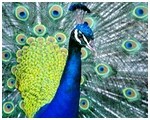 |
12 The teem theory of sexual selectionDarwin’s theory of sexual selection explains that evolution is often driven by mate choice, whereby an individual, (usually a female) develops a preference for males displaying certain traits. In this way, he argued, peacocks evolved large flamboyant tails, not because they were adaptively useful, but because they appealed to females.While this brilliant theory has since been confirmed by modern researchers, so far, no one has demonstrated how the female’s sexual preference is first genetically encoded into her DNA. The theory of ‘sexual preference teems’ appears to finally explain this. Typically, a sexual preference teem occurs when a female is so emotionally overwhelmed by a male displaying some new behavioural or physical trait she encodes her ‘attraction emotions (desire, love etc) into a new teem. Once encoded into her DNA, the powerful attraction emotions are inherited by her offspring who will prefer males displaying the same trait. |
 |
13 Teem theory of speciationExtending the teem theory of sexual selection, it appears plausible that new sexual preference teems are a major factor in speciation – the creation of new species. According to this hypothesis, new species are created when an individual (usually a female) encodes a new ‘sexual preference teem’ that redefines her choice of breeding partners. Although the female’s offspring can theoretically interbreed with members of the parent population, because they inherit their mother’s teemic preference, they will only choose males that display the preferred trait, be it a physical characteristic or a particular behaviour (ie, a dance or other display.)In this way, a viable new sibling species can be created within a few generations. I suggest that most new species evolve by this means. |
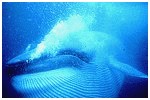 |
14 Teem theory of animal sizeWhy do species vary so greatly in size? Biologically, there is no uniform trend towards larger species; no hard and fast evolutionary rule that says animals must get bigger. Insects, among the most successful and numerous creatures on Earth have remained minute while the Indrichotherium, the largest mammal of all time, is now extinct. In the sea, organisms vary from microscopic plankton to 30m long Blue whales weighing over 112 tonnes.In the absence of any scientific consensus that would explain the enormous disparity between species, I propose that the size of animals, (including humans) is controlled by a subset of ‘sexual preference teems’ that I call ‘size preference teems.” Because size, shape, scale and even weight can be easily transduced into the teemic emotional language, females can encode a range of size preference teems – from ‘big is beautiful’ to ‘small is sexy.’ Once a female has teemically encoded her ideal mate size, she will only mate with males of the correct size. To show how this works, imagine way back in their mammalian past, a single female whale - at the time no bigger than a dog, may have encoded a ‘bigger the better teem’ - and the race was on. By only mating with the biggest whales, her descendants eventually created today's majestic leviathans. |
 |
15 The origins of teemosis hypothesisThis hypothesis dates the evolutionary origins of teemosis to the Cambrian-Vendrian boundary, approximately 543 million years ago.According to this theory, all complex instincts, emotions plus the evolution of biological complexity and species diversity date from this time. Before that, evolution was moderated exclusively by NS. After that date, evolution was moderated by both NS and teemosis. The emergence of teemosis at the basal Cambrian was I suggest, the most significant moment in the history of our planet. Teemosis revolutionized life on Earth. |
 |
16 Darwinian instincts hypothesisThis theory asserts that for the first 3.2 billion years of life prior to the Cambrian emergence of teemosis (and the advent of the first complex instincts), innate behaviour and instincts existed but only in a very rudimentary form.These ‘Darwinian instincts’ as I call them were in fact merely ‘reflex actions’ – simple gene based stimulus- response behaviours that facilitated basic survival in simple species. Significantly though, because they were derived from random mutations, these reflex actions could only be very simple and certainly didn't incorporate environmental factors. Once teemosis emerged, Darwinian instincts were relegated to a minor role in behavioural ecology. Today, most animals, (including humans) still retain a few simple reflex behaviours. |


Home
Copyright:
2005 by Danny Vendramini